Monday, May 09, 2005

Your Company's Secret Change Agent

Harvard Business Review, May-June 1996
Reaching and Changing Frontline Employees


"We have watched employees turn the slogan Quality is Everything We Make into Quality is Everything We Fake... The frontline workforce is not sprinkled with a handful of cynics; it is cynical through and through.": T.J. Larkin and Sandar Larkin

Harvard Business Review, May 2005
Your Company's Secret Change Agents

"Learn from the people
Plan with the people
Begin with what they have
Build on what they know
Of the best leaders
When the task is accomplished
The people all remark
We have done it ourselves": Lao Tzu


"Newton was right: Every action has an equal and opposite reaction. In organizations, that reaction comes in the form of avoidance, resistance, and exceptionalism ... The trick is to introduce already existing ideas into the mainstream without excessive use of authority. Why use a sledgehammer when a feather will do? ... People are much more likely to act their way into a new way of thinking than to think their way into a new way of acting.": Richard Tanner Pascale, Associate Fellow, Oxford University, and Jerry Sternin, Assistant Dean, HBS

Fresh out of college when I first started working, one of my first bosses Darrell told me, "Yeah, go ahead with your proposal. But make sure you work with the operators. First explain what you're trying to accomplish, then ask them if your solution would work."

As a fresh engineer then, I could not possibly out-think the operators. So you could also say that I was following Darrell's advise more out of necessity than anything. I listened to each of their opinions and worked really hard to get those that make sense implemented. And those that didn't? I explained to them the potential problems of those ideas and hinted alternative solutions that were (made to sound as if) built upon the operators' originial ideas. Somehow, the operators were adapt to change.

But as I grew comfortable to the processes, I began to overrule the operators a lot more often. I began to get lazy and stopped pushing hard on plant management to get things done from their part. While I still drove these initiatives to completion, somehow these changes never sticked. Lesson learned.

Sunday, April 24, 2005

We Don't Need Another Hero; We Just Need Another Marla: Marla Ruzicka, 1976-2005

Harvard Business Review, September 2001
We Don't Need Another Hero


"Everybody loves the stories of great leaders, especially great moral leaders. Think of Martin Luther King, Jr., Mother Teresa, and Gandhi. We exalt these individuals as role models and celebrate their achievements. They represent, we proclaim, the gold standard of ethical behavior ... Or do they? I don't ask because I question the value of ethical behavior--far from it. I ask because over the course of my career as a specialist in business ethics, I have observed that the most effective moral leaders in the corporate world often sever the connection between morality and public heroism.": Joseph L. Badaracco, Jr., Professor, HBS

Before a road car-bomb killed her in Iraq, Marla Ruzicka wasn't a hero. "Now I wish I'd pushed harder so that more people might have known about her when she was doing her work," writes Christopher Allbritton, an Iraq-based journalist. But Marla was busier in the streets of Afghanistan and Iraq than she was looking for a best way to get into a prime-time spot. Marla learned that the most effective way to right moral wrongs was not through loud protests aired by CNN. Instead,--according to The Washington Post--through her quiet diplomacy, she earned the ears of journalists, generals, and politicians--most notably Sen. Patrich Leahy, D-Vermont, who helped her cause in obtaining $17.5 million appropriation fund for Afghanistan and Iraq war victims.

"No one can heal the wounds that have been inflicted; you just have to recognize that people had been harmed.": Marla Ruzicka, Founder and Director, CIVIC Worldwide

For more info: Wikipedia entry on Marla Ruzicka

Saturday, April 09, 2005

Long-Term Vision, Short-Term Focus

The Wall Street Journal, April 5th, 2005
Chiefs With the Skills of a COO Gain Favor as Celebrity CEOs Fade


"I'm only as popular as the company's last quarterly results": Mark Hurd, CEO, H-P

It's the eternal debate over long-term vs. short-term interests. We have often accused our managers and CEOs of sacrificing long-term goals for short-term gains. But the generally accepted fact is that the best-run companies are those who maintain short-term focus: GE, Siemens, Dell, ... In the meanwhile, all the "invent" companies out there sooner or later will realize or have realized that they have/had been using their long-term dreams as excuses for underperformances.

Harvard Business Review, January-February 1989
Companyism and Do More Better

"Rowing harder doesn't help if the boat is headed in the wrong direction.": Kenichi Ohmae

Dreamers and visionaries make great leaders, we hear. But the problem with dreaming without executing is that it gets you nowhere. The problem with long-term vision is that you can only guess what is there beyond all those obstructions along the way. So the short-term gains may not be so evil, after all. Taking a note from Finance 101: "a dollar now worths more than a future dollar; a dollar in hand worths more than a promised dollar". It is important to establish checkpoints to earn the short-term gains as well as to ensure you're headed in the right directions.

Thursday, April 07, 2005

Execution without Excuses

I have always wondered if our company is the HP of the personal computer world. We do not do rocket science, but fortunately we do sit inside some huge walls of economies of scale and know-hows created by high capital and technological intensity required in our industries. Still, the following quotes from Michael Dell might hold true even for our industries:

Harvard Business Review, March 2005
Execution without Excuses


"I founded the company over 20 years ago with $1,000 in starting capital. By contrast, Compaq had been launched two years earlier in Texas with some $100 million in capital. That's an unbelievable difference. Dell bubbled up through a kind of Darwinian evolution, finding holes in the way the industry was working. We didn't become asset-light just because it was a brilliant strategy. We didn't have a choice.": Michael Dell

(In the "Lean Enterprise" training, we learned how the "sea of inventory" covers all the rocks of process imperfections and wastes. Big companies sit on huge levels of inventories so they will never have to bump these rocks. But because they don't see these rocks, big companies generally do not have as much incentives to continue moving forward towards perfection.)

Monday, March 14, 2005

"People Quit People Before People Quit Company"

"People quit people before people quit company." I'm not sure where I heard this first. When I tell others that I don't work for money, they'll snap back "yeah, but you're different". Am I? I might be on the extreme end of the spectrum, but I believe most people are--in most way--like me. We work because we feel appreciated; and that by working harder, we will learn more and therefore, the more we will be valued by our supervisors and our company.

Harvard Business Review, February 2005
Transforming an Industrial Giant


"First was the very simple message: Be number one or two in each business, or you will not be successful ... The second thing I admired about GE is that people are really the most important thing. I always wondered why they have such excellent people. Was it just that they pay more in the U.S.? I realized it was their people development program--Section C.": Heinrich von Pierer--CEO, Siemens AG

Harvard Business Review, April 2004
How Fleet Bank Fought Employees Flight

"The results of the analysis seemed to suggest that inadequate pay and heavy workloads were the key drivers for turnovers. Management tried to address some of these concerns by tracking market pay more systematically and by offering more flexible working arrangements ... Yet to Fleet's surprise, turnover rates continued to rise rapidly. Indeed, many companies have found little relationship between what employees--particularly departing employees--say motivates their behavior and what actually does.": Haig R. Nalbantian, Principal, Mercer Human Resources Consulting, and Anne Szostak, Executive VP and Director of Human Resources, FleetBoston Financial.

So Fleet utilized some kind of a "Design of Experiment" method by changing several variables and observing the impacts of the variable changes on turnover rates. The following is the top 5 variables that reduced Fleet's turnover ratio:

1. Promotion within the past year reduced turnover rate by 11%
2. Incentives reduced turnover rate by 8%
3. Continuity / same group supervisor within the past year reduced turnover ratio by 7.5%
4. High school educated employees on average had a turnover rate that is 5% lower than their college-educated counterpart.
5. 10% reduction in layoffs reduced turnover rate by 3%.

On the other hand, the following variables had less than 1% impact in reducing turnover rate:

15. 10% market pay adjustment
14. One-point increase in regional unemployment rate
13. One year increase in tenure
12. Increase in local market share from 10% to 20%
11. 10% reduction in worked / scheduled hours

Money does matter, but not as much as how it matters. Promotions and incentives go a long way in telling people how much they are valued, while a simple market pay adjustment might convey the message that "we have been underpaying you all along".

Sunday, March 13, 2005

A Taboo on Taboos

Are we in a commodity business; should we compete on price, or should we be competing on quality and customization? Are our Marketing and Research & Development adding value, or are they the unncessary evil? Can we be Intel, or should we become a Dell?

Harvard Business Review, February 2005
Breakthrough Ideas for 2005


"A reporter sniffing around PeopleSoft's user conference last fall was surprised by what she didn't smell: fear. Despite the sword of Damocles suspended over their investments by Oracle's hostile takeover bid, customers discussed 'comfortable subjects regarding PeopleSoft's business administration programs, such as new features they'd like to see in the next version--rather then whether there will even be a next version' ... The worst thing about elephant in the room is that if you ignore them long enough, they become invisible. That's what happens when companies avoid subjects because they are politically dangerous, socially unacceptable, or just too dire to contemplate. The result can be a failure to anticipate predictable developments and consequent errors in the strategy.": Leigh Buchanan, HBR, Senior Editor

Thursday, March 10, 2005

Two Sides of the Brain

I was recently accused by my close friend of sacrificing a long-term dream for some short-term gains. My thought-process and the discussion were a lot more complicated, but yes, I might have made some impulse decisions. Which, according to The Wall Street Journal / adapting a report from the Fortune magazine, was a human-nature:


"Why is it so hard to save for retirement? It may have something to do with how our brains are wired. When researchers at Princeton University's psychology department ran brain tests on undergraduates, they discovered that humans are of two minds, writes Justin Fox in Fortune magazine. The research showed that when it comes to money matters, part of the brain is hard at work making calculations and weighing options. But when participants in the study opted to get their money now, the more primitive limbic system of the brain 'lit up as if it smelled dinner.'"

Friday, March 04, 2005

Wanted: A Continuity Champion--The Case for Staying On Course

Don't get me wrong: I have often been praised (and cursed, too) for my persistence in driving changes.

But sometimes, I can be (and need to be) stubborn too. I believe there are times when you can't change just for a change's sake. And this includes my job. Sometimes there are disagreement, and sometimes you don't get treated fairly. But you will get this everywhere in any job.


Harvard Business Review, February 2005
Breakthrough Ideas for 2005


"The ability to champion change is the very mark of a leader, we hear. Change agents are sexy by business standards. They battle strong vested interests and mankind's reluctance to rock a boat, even (or especially) if it leaks. Change will not happen without their heroic assistance ... the defenders of status quo too often appear to be--and are--knee-jerk naysayers who champion the wrong continuity. It's more glamorous to be Napoleon (who gained and lost an empire in little more than a decade) than Hadrian (who gave the Roman Empire a stability that endured for generations) ... But 'coping with change' can mean standing firm against a tide. 'Setting direction' can mean staying the course. Part of the leader's job is to evaluate the threats and opportunities that change creates.": Thomas A. Stewart, Editor, HBR

And sometimes, the discussion also turned to my present career. Some people think that I would be better off doing something different, because some think that I have accomplished quite a lot. Well, I take that as a compliment, but, really?

I recognized that I had done many good things. But humbly, I too recognized that I might not have done them as well without the support of the team and the environment that I currently had. And this is why I do not seek always seek change just for a change's sake.


Harvard Business Review, May 2004
The Risky Business of Hiring Stars

"Our data showed that 46% of the research analysts did poorly in the year after they left one company for another. After they switched loyalties, their performance plummeted by an average of about 20% and had not climbed back to the old levels even five years later ... Most of us have an instinctive faith in talent and genius, but it isn't just that people make organizations perform better. The organization also makes people perform better ... When researchers studied the performance of 2,086 mutual fund managers between 1992 and 1998, they found that 30% of a fund's performance could be attributed to the individual and 70% was due to the manager's institution.": Boris Groysberg (Assistant Professor, HBS), Ashish Nanda (Assistant Professor, HBS), Nitin Nohria (Professor, HBS)

Friday, February 11, 2005

Men = Bugs = Monkeys ... According to The Wall Street Journal

Some fun Valentine-Day facts ... you know, I've always wondered why I (read: men) do the things we do. But heck ... I guess it was just our (ir)rational nature?

The Wall Street Journal, February 11, 2005.
Do the Mating Habits of Bugs Offer Lessons for Human Valentines?


Take gift giving. Tiny creatures called dance flies don't have an ornate tail or much else to signal their sex appeal as, say, peacocks do. So the male shows off his fitness through his largess, bringing a female a big dead fly, for example, so that she can nibble on it while he mates with her.

But among some dance flies, cheating is rampant. Over the years, (scientists) suspect, a few males decided to heck with lugging along a dead fly to their assignation, and instead bestowed just an insect fragment, wrapped in easily carried silk to make it look bigger. Getting good results, some males began skipping the snack and presenting just a worthless wisp of silk. That way, they got to invest less in sex (less foraging for a nuptial gift) and still reap all the rewards.

Whether the behavior of dance flies and crickets holds any lessons for humans is left as an exercise for the reader. But if you doubt that people make bizarre mate choices, consider this little study. It is a common observation that in poor cultures, men tend to prefer heavier women, while in wealthy cultures they prefer thinner ones. A team of psychologists therefore made young male volunteers in New York feel poor or rich.

Sure enough, when the men felt poor (they compared their bank accounts to a millionaire's) their stated "ideal" woman weighed more than when they felt well-off (comparing their bank accounts to a pauper's).

Monkeys Are Willing to 'Pay" for a Glimpse of High-Status Apes

During the experiment, four monkeys named Wolfgang, Sherry, Dart and Niko were seated in chairs facing a computer monitor, as researchers electronically monitored their gazes. The monkeys watched a slide show featuring pairs of photos taken of their 12-member troop. Viewing a particular image triggered a squirt of juice.

The monkeys' gazes showed a clear preference for power and beauty, no matter the cost. They chose to look at pictures of alpha monkeys of both sexes, and potential female mates, although they had to sacrifice -- or pay more for the view -- by accepting 10% less juice. The photos were of faces of male and female alphas, and, in keeping with how monkeys judge a potential mate's receptivity, the backsides of females.

All primates living in complex societies have evolved this drive to study what's around them, Dr. Glimcher explained. "People are willing to pay money to look at pictures of high-ranking human primates. When you fork out $3" for a celebrity gossip magazine, "you're doing exactly what the monkeys are doing."

Wednesday, February 02, 2005

Flipping Without Flopping

Can we change our mind? According to Professor Kramer from Stanford Graduate School of Business, we can ...

While decisiveness is important in leadership, acknowledging a mistake and take an appropriate correction is also important. And sometimes, in this constantly changing world, it is required.

I too may have to make a change of plan soon ...

Harvard Business Review, February 2005
Breakthrough Ideas for 2005


"Flip-flopping is not the same thing as indecision - roughly, the inability to arrive at a choice. Rather, it means altering a stance after a choice has been made ... It is a way of saying that I'm wiser today than I was yesterday.": Roderick M. Kramer, Professor, Stanford GSB

Tuesday, January 04, 2005

Sumatra Tsunami (originally posted 12/28)

I appreciate the emails and phone calls regarding the recent tsunami disaster near the island of Sumatra, Indonesia. While my immediate family is safe in the island of Java ... some good 1,000 miles away from the quake's epicenter and is well-shielded from the tsunami by the island of Sumatra, the tsunami had killed more than 100,000 people in Sumatra and wiped out hundreds of thousands of homes. Food-borne, water-borne, and air-borne diseases loom. Drinking water, food, and clothes are scarce. Millions are out of jobs as their shops, fishing boats, farms, and other structures and infrastructures are badly damaged.

For more information and ways to help, please see the official site of Indonesian Embassy in Washington, D.C. You can also channel your donation through American Red Cross, or through
the Amazon.com's "One Click" American Red Cross Disaster Relief Fund if you have an account with Amazon.

Thursday, December 23, 2004

Cup'oCofi?

"525,600 minutes, 525,600 moments so dear. 525,600 minutes - How do you measure, measure a year? In daylights, in sunsets, in midnights, in cups of coffee? In inches, in miles, in laughters, in strife? In 525,600 minutes -- How do you measure a year in the life?"

I adopted the nickname Cup'oCofi from a phrase in the theme song "Seasons of Love" from the popular musical "The Rent" which I saw back in 1999. I guess I like the phrase because it keeps reminding me to ask "how have you been measuring a year in your life?" As Mel Gibson's William Wallace puts it: "Every man dies. But not every man really lives."

So I started this Blog to log all the ways to measure a year in my life. I hope it can be a source of inspirations and motivations for me, and for all who care enough to read my postings.

(Please continue reading this month's archive for some catch-up blog in chronological order.)

Pre-1997: Home Sweet Home Jakarta

Honestly, it was difficult to make the decision to leave home. Especially when "home" provided me with everything I needed.

Food? OK, at about 2 dollars per meal, McDonald's was probably a luxury, but Indonesia was home to some of the best cookings in the world, available from the street vendors for about 20 cents per meal. And I'm not talking fast food. Real cooked meals.

Laundry? If I put my clothes in the laundry basket--instead of on the bathroom floor--my mom would be happy.

Parents? They lived some 3 hours drive away. No, I did not live in boarding school. I had a townhouse all for myself.

Well, almost everything.

When, in 1997, I received offers of admissions to reputable universities in the US but was denied admissions to Indonesia's public universities, the decision was made for me. If I had to go half-way around the world to get better, so be it.

Which, in retrospect, was a blessing in disguise.

1997 - 2001: Washington University in St. Louis

Washington University was my school of choice because of both its location and reputation.

Location?

Yes. Most Indonesians would have gone to either the West coast or East coast school where they could form their own "little Indonesia" community. At the conclusion of their studies, they still spoke broken English.

I chose St. Louis so I would not get that option.

What I did get was the luxury of knowing some of the brightest--and friendliest--minds in America who just enjoyed of having me around. My roommates Ralph and Chris, my RA Saskia, and my entire "Shepley 5" floormates helped me to integrate into American culture and college life. They helped me break the language and cultural barriers.

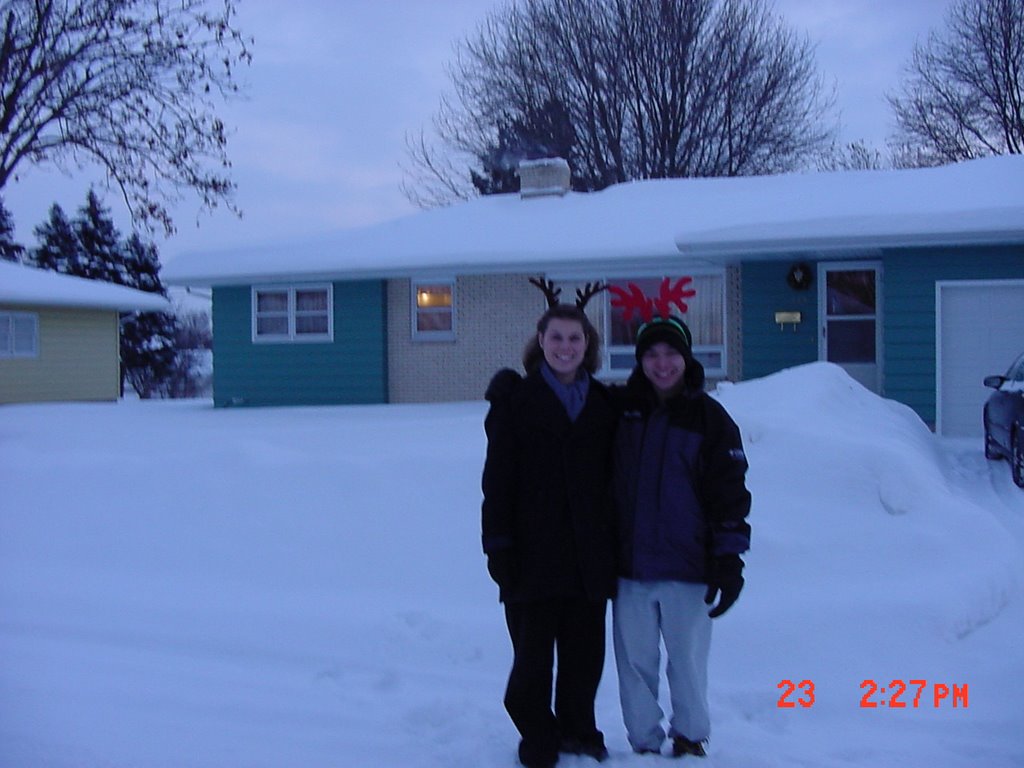
In my second year I became close friend with Laura, a Wisconsin girl who invited me to Wisconsin to celebrate the traditional American holidays of Thanksgiving and Christmas, and to see the 6 foot of snow in Wisconsin's December landscape. With her help, by the third year I had mostly American and international friends, and English began to take over as my first language.

In retrospect, I really don't think I could've done any better (though the credit really goes to Shepley 5, Laura, and many others--including my acting teacher Andrea).


Wisconsin snow, December 2000


Take me out to the baaallgame ... graduation ceremony


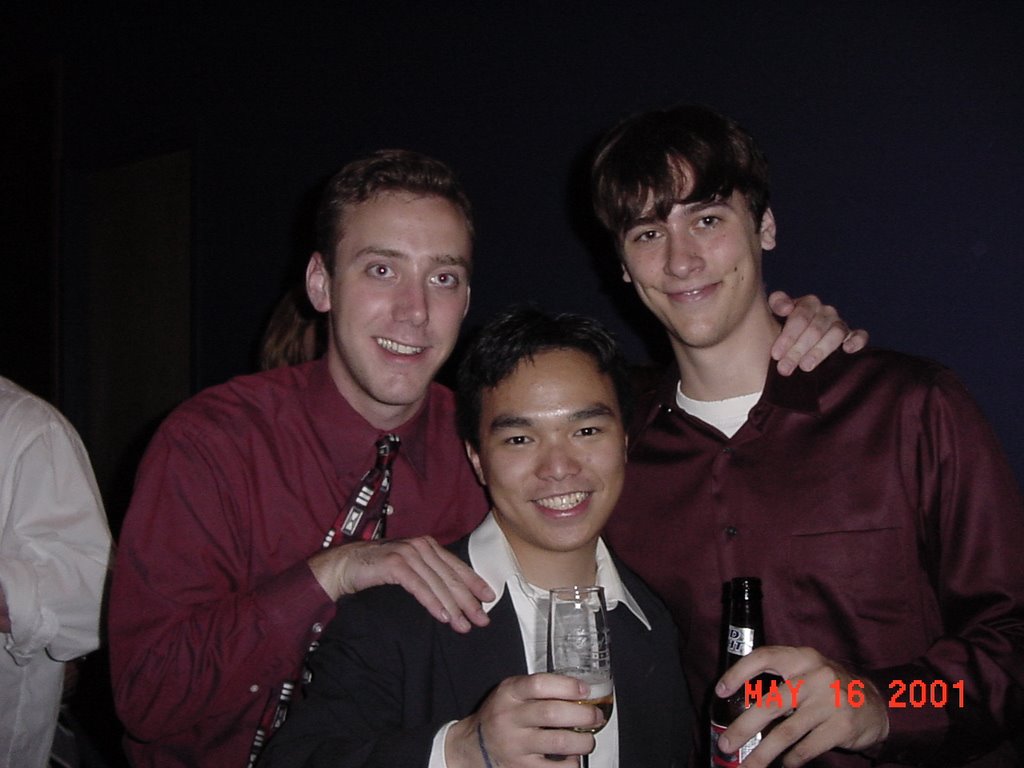
Suitemates (J, Kev, Tim) - graduation ceremony


Graduation gala with the special friends

Post-Graduation Road Trip!

St. Louis --> Chicago --> Wisconsin --> South Dakota --> Montana --> Yellowstone National Park --> Idaho --> Seattle --> Portland --> San Francisco --> California SR-1 --> Los Angeles --> San Diego (Surf Camp) --> Santa Cruz --> Berkeley, California

Summer Destination: University of California, Berkeley (Chinese Class)


Mt. Rushmore - May 2001